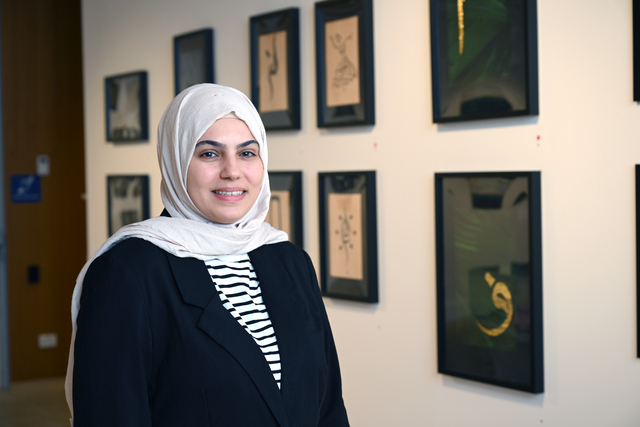
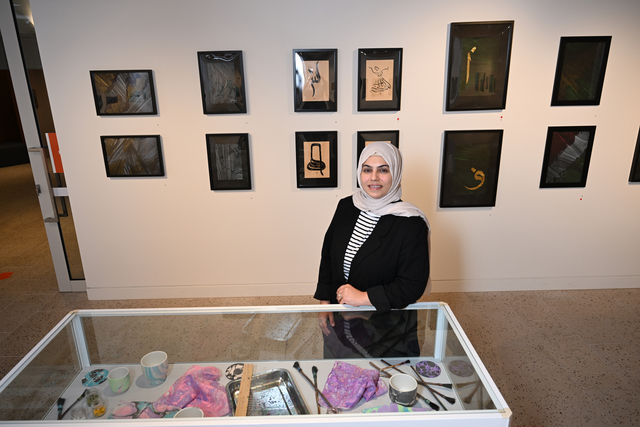
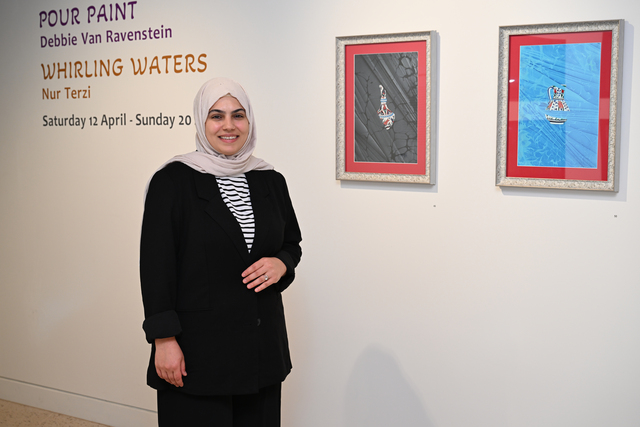
PRECEDE: Greenvale artist Nur Terzi is presenting an exhibition at the Sunbury Hume Global Learning Centre titled Whirling Waters, expressing physical and spiritual motion across Turkish ebru paper marbling, illumination, and Islamic calligraphy. Oscar Parry spoke with Terzi about ebru and the influences behind her works.
As whirling colours spread across the surface of water, ready to be transferred to paper, Greenvale artist Nur Terzi feels a strong sense of calm.
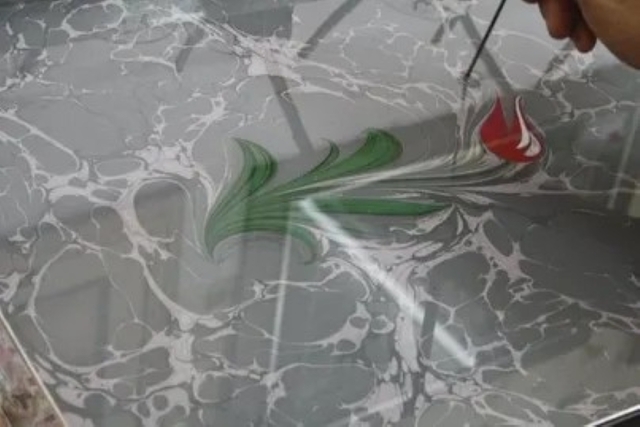
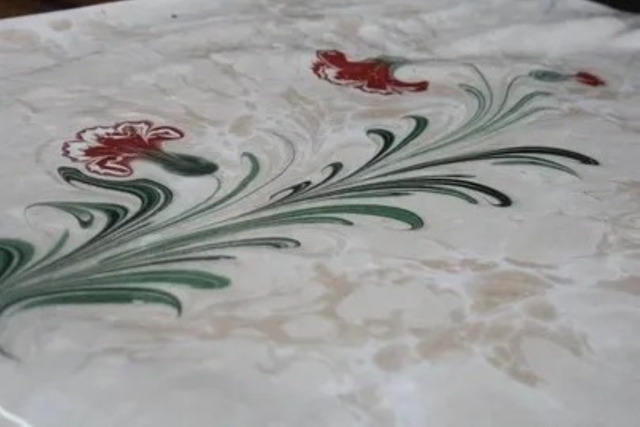
This is part of the nature of ebru – also known as Turkish paper marbling – a traditional and meditative art form where intricate patterns are created by floating paints on the surface of water.
Terzi explained that ebru as we know it today originated in central Asia and travelled through Persia, before flourishing in Ottoman Türkiye – particularly from the 15th century onward.
It is achieved by thickening the water with a natural substance called kitre, made from tree sap or carrageenan, which helps the paints made by mixing earth pigments with ox gall float and spread across the water.
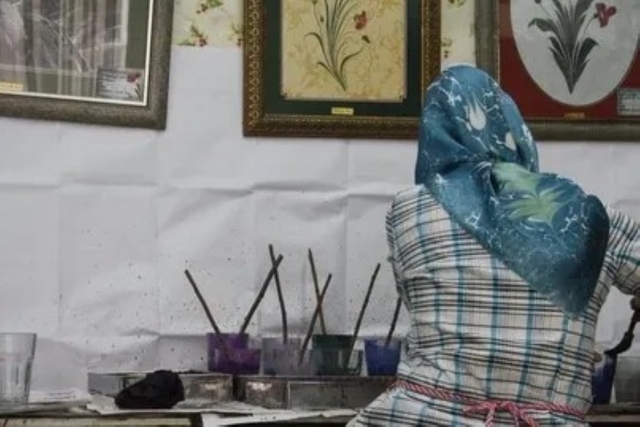
She said brushes made of rose branches and horse hair, combs, or styluses shape this paint to create patterns, which are then carefully transferred onto paper that is often handmade or specially treated.
“The beautiful thing about ebru is that no one paper … is the same. Once you pick it up, that’s it. There’s no residue left. So it’s a monoprint … which is a very unique form in itself,” Terzi said.
“I don’t know how it’s going to be reflected on the paper, depending on … what kind of day I’m having, or what I’m experiencing, a totally different artwork can come out. So there’s a lot of … patience … and being in the present in the moment,” she said.
She explained that ebru and this process of letting go and being present aligns with the teachings of Rumi, the 13th-century Sufi poet and mystic, and Sufism more broadly.
“Rumi’s poetry speaks to the heart – it’s about love, surrender, inner transformation, and the soul’s connection with the Divine. These themes are very much present in my work,” Terzi said.
“Ebru and Sufism share a strong spiritual connection. Both embrace flow, surrender, and presence. In ebru, the artist doesn’t fully control the outcome – the paint floats on water, and we guide it gently, but we must also let go and trust the process.
“That idea of releasing control and becoming a vessel for beauty, that’s very Sufi.”
Terzi uses a form of ebru called dalgalı ebru – or wave marbling – which is a technique that generates ripple-like effects in the finished ebru art piece.
She said that in her latest exhibition Whirling Waters, these ripple-like effects form the central theme of “movement – both physical and spiritual”.
This movement is inspired by that seen among Sufi Dervishes performing whirling – a meditative Sufi practice.
“Whirling Dervishes are at the heart of the series. Their flowing motion symbolizes the rhythm of nature, the turning of the universe, and the soul’s journey,” Terzi said.
“I shake the paper in different directions and in different strengths … and different vibrations to give that wave effect. Even though it’s on a 2D paper it gives the effect of a 3D sort of waves and patterns as well … just like the motions, like the rhythms in nature and also the motions of the Dervish.”
Terzi said her approach applies a modern twist to traditional art forms, including in her choice of colours for her ebru works.
“There are a lot of more natural colours in traditional ebru, like the browns and the greens … it’s very in line with nature, the sky, flowers … whereas with me I’ve used very non-traditional colours, so I’ve got very dark backdrops, it’s almost like it’s luring you in … deep purples and deep greens and golds … to give that sort of hypnotic effect,” she said.
She said ebru and its process has a meditative and calming quality – and she often complements the process with the sound of ney – a type of flute used at whirling Dervish ceremonies.
“That effect shouldn’t go unnoticed, because … in Ottoman times, ebru was used as a form of art therapy, and it was practised in … houses of healing, sort of institutions that people would go to – usually they were women after giving birth … [or] people who had anxiety, lower levels of depression,” she said.
Her exhibition will also present her works across tezhip – or illumination, a form of intricate decoration involving floral motifs – and Islamic calligraphy.
She explained that ebru, tezhip, and calligraphy “feed off one another,” where ebru artworks are used as the backdrop for the other art forms.
Terzi said her history with art spans back to when she was very young, and as both of her parents were born in Türkiye, she often made visits to the cities of Istanbul, Konya, and Bursa.
“[This] left a deep impression on me. I was always drawn to the patterns, the domes, the tiles, and the spiritual energy in those spaces. Even as a child, I remember being captivated by the beauty and meaning woven into every detail,” Terzi said.
“It wasn’t until university in 2008 that I began to formally study traditional Turkish arts. That’s when I was introduced to ebru – and I instantly felt a deep connection. It felt like a return to something I had always carried inside me.
“Eventually, I made the decision to move to Istanbul to pursue this passion seriously. There, I entered into the traditional master-apprentice system, immersing myself in ebru, and later expanding my practice to include tezhip and Islamic calligraphy.”
She said learning these art forms is a “lifelong path,” and she continues as a student to send homework digitally to her teachers and keep that traditional connection alive across borders.
“It’s a relationship based on trust, discipline, and deep respect – just like it has been for centuries,” she said.
She said her goal is to keep the tradition of ebru alive in a contemporary context, “celebrating it while making it accessible and meaningful to audiences today”.
“Through exhibitions and workshops, I hope to raise awareness of ebru’s rich heritage and its continued relevance,” she said.
“Ebru is recognised by UNESCO as an Intangible Cultural Heritage, highlighting its cultural and historical importance.”
Terzi received an artist grant from Hume council in 2024, which she said allowed her to ship her ebru materials from Türkiye, further develop her art, and support her to be selected to present her work in an exhibition.
With the opening night held in early April, Whirling Waters is being presented at the Gallery at Sunbury Hume Global Learning Centre until Sunday, July 20.
Terzi will also be hosting workshops on Turkish floral art at Craigieburn Library on Thursday, August 14 at 6:30pm, Broadmeadows Library on Thursday, September 4, and a workshop on sacred geometry at Tullamarine Library on Thursday, September 11 from 5.30–7pm.
Further details on the exhibition are available on the council’s website.