On February 13 this year, a bushfire raged through the beautiful Grampians area of Victoria where my family and I are fortunate enough to have a property. The bushfire began at Bellfield and ravaged an area of 2726 hectares.
The fires began because of lightning strikes as extreme storms hit Victoria after a series of hot days. The other contributing factor was that the bushfire fuel, such as grasses, leaves and undergrowth, had a low moisture content after a long, dry summer, meaning that combustion was rapid, and the fire spread easily
When we finally witnessed the damage to our 2.5-hectare property a week later, a large shed and its contents had been destroyed and the landscape across the whole area was a moonscape, charred and shrivelled with tree trunks still burning and smoking. Our family have a dedicated firefighting crew to thank for the survival of our house, which fortunately remained untouched.
What has struck me as remarkable about the recovery after the fires is that the plants have intuitively begun the regeneration process without any intervention. The internal mechanisms and processes plants undergo ensures that they are equipped to tackle post-fire recovery better than any animal, including humans.
Some trees and plants refuse to die even in the face of 1100 degrees celsius flames, the maximum temperature at the base of tall flames. To the naked eye, plants scarred very recently by fire can look as if they have died. However, after a week or so, the plant springs into action and begins to regrow in the way it knows how. Plants that can survive a fire are called ‘resprouters’ and those killed by fire are called ‘fire sensitive’.
There are three main ways that a plant resprouts after fire:
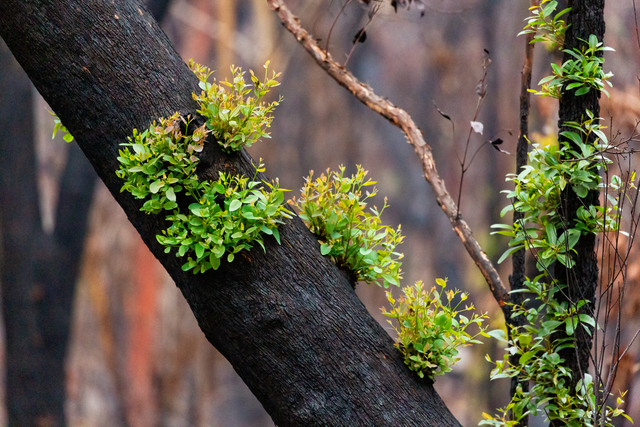
1. Trees and some shrubs have dormant buds beneath their bark and these buds survive the heat of a fire. This growth known as Epicormic growth can occur in Eucalyptus and small trees. What you will see is sprouting leaf growth that is almost feathery in appearance along most of the tree’s trunk area and into its branches.
2. Many shrubs, grasses, sedges, lilies, terrestrial orchids and ferns regrow after fire from dormant buds in underground organs. These are protected from the heat of fires by the soil. This is particularly striking in the grass trees on our property which have resprouted like bright green fibre optics from the blackened trunk.
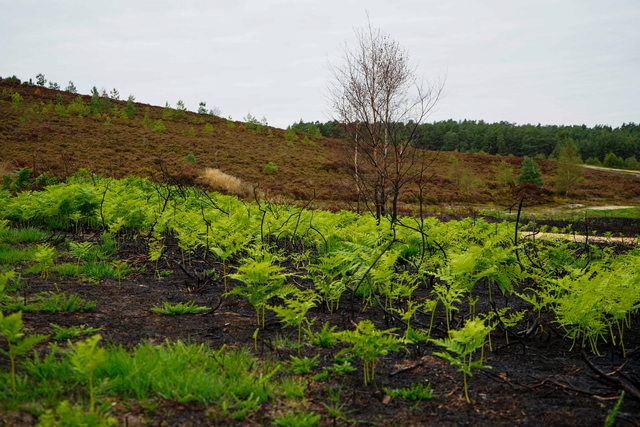
3. Some plants regrow from buds protected from the heat of fires by leaves or old leaf bases. These tiny plants emerge from a seemingly arid, empty patch in the darkened soil.
Then there are the plants that are fire sensitive. Of the plants that do die when burned by fire, these plants have two ways of regenerating that rely on accessing the plant’s seed bank. Firstly, the plant may store these seeds in the woody fruits of the branches, and they will be opened by fire. Alternatively, the plant stores it’s seeds in the soil and the seeds will wait until the fires have passed before germinating . Just goes to show the resilience of the plant world!
So, four months on from the fires, the plants have begun to assert themselves once more. Blackened tree trunks and branches have a leaf cover of epicormic growth, bracken ferns have replaced the blackened sandy soils and fresh sprouting leaves emerge from what appears to be a barren, bare and flimsy shrub.
Where possible, it is best to leave plants to recover with minimal human intervention after bushfire. The fires were tough on animal life too; accordingly, part of the recovery humans can help with is to leave behind burnt logs and some debris as homes for wildlife.
If you are interested in being more prepared for a fire, you may wish to know more about fire resistant plants. The key to using fire resistant plants is to choose plants with high water content to reduce and slow the spread of fire. It is also smart to use trees or hedges, where possible to reduce wind speed, radiant heat and to filter embers.
There are books and websites that can offer advice on plant choice and provide you with further information. A couple of reliable sources are The Diggers Club website The Diggers Club – Australia’s No.1 Gardening Club and Lesley Corbett’s thoroughly researched book called Safer Gardens: Plant Flammability & Planning For Fire Safer Gardens: Plant Flammability & Planning For Fire – Australian Scholarly Publishing.